Before the Home Refrigerator: How Food Preservation Changed Household Routines
Before the home refrigerator, drying, salting, and cool storage shaped shopping, cooking, and leftovers. See how refrigeration changed each household routine.
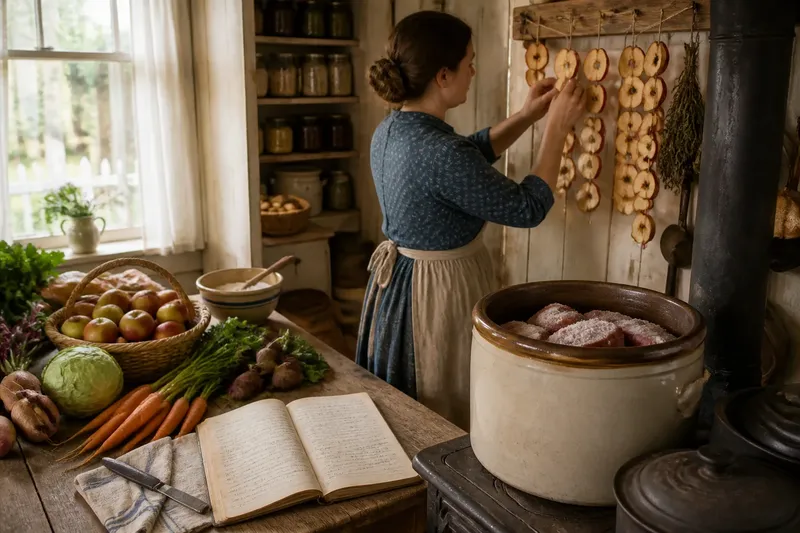
At dusk, a cook hangs sliced apples near the stove, checks a crock of salted meat, and plans tomorrow’s meal around what might spoil first. Before the home refrigerator, food preservation was not a separate appliance task; it organized the day. The arrival of household refrigeration shifted that work from visible, recurring chores toward a cold cabinet that could hold many foods at once.
Imagine a clearly invented household in a small town, with a garden, a market within walking distance, and no refrigerator. Its members are not trying to recreate a modern kitchen without one. They are responding to what the weather, storage space, available materials, and food itself allow. Following their routine shows what changed when refrigeration became common—and what did not simply disappear.
Food preservation began with decisions about time
The household buys or harvests food in forms that suit its storage. Apples can be dried; beans can be kept dry; meat may be salted or smoked; milk and cooked dishes need prompt attention. These methods do not make food immune to deterioration. They alter conditions so that some foods can be kept longer, while requiring suitable preparation and storage.
Drying removes moisture. Thinly cut fruit or herbs can be spread where air circulates, then protected from dampness and pests. The work depends on weather and space: a humid spell can make drying difficult, and a crowded room offers fewer good places to hang or lay food. Dried food also changes in texture and often needs soaking or cooking before use.
Salting draws moisture from food and gives it a distinctive flavor. A crock or barrel can hold salted foods, but the household must keep the container and contents in a condition suited to that method. Salted meat is not interchangeable with fresh meat at supper; it may need preparation to reduce excess salt, and it shapes the dish around it.
Cool storage uses a naturally cold place, such as a cellar, shaded room, or icebox when ice is available. It can slow spoilage for some foods, but conditions vary by season and location. A cool cellar is not the same as controlled refrigeration, and the household cannot treat every perishable item as if it will remain safe indefinitely.
Preservation therefore starts with a practical question: how soon will this food be used, and what form of storage suits it?
The household plans meals around perishability
In the imagined household, shopping is tied to the order in which food needs attention. Fresh milk is used promptly. Leafy vegetables are cooked before sturdier roots. A piece of meat may be salted or prepared for a meal soon after purchase, depending on the available method. Dried beans and apples can wait, so they fill gaps when fresh supplies are limited.
This changes the meaning of a meal plan. Rather than choosing any dish from a broad inventory, the cook asks which ingredients need using and which can wait. A stew might absorb vegetables that are nearing the end of their useful storage, while a dry pantry supplies the rest. The plan is partly culinary and partly a response to time.
Food preservation also distributes labor across the household. Someone has to cut fruit, tend a drying area, keep storage vessels clean, monitor a cool space, or prepare preserved ingredients for cooking. Those tasks may happen in batches after harvest or after a market visit. The preserved food is convenient later, but producing that convenience takes work earlier.
Say the household brings home more apples than it can eat while they are in good condition. It sets aside sound fruit for cool storage and slices the rest for drying; later, the dried pieces can go into porridge or a cooked dessert. The observable result is a smaller pile of fresh fruit demanding immediate use and a stored ingredient with a different texture and role.
Refrigeration moves preservation into an appliance
When a household refrigerator becomes part of the kitchen, it changes where preservation happens. Instead of relying mainly on a cellar, a crock, a drying area, or an icebox, the household gains an enclosed space designed to keep foods cold. Fresh milk, vegetables, leftovers, and ingredients for the next meal can be stored together, subject to the refrigerator’s capacity and the food’s needs.
The most noticeable shift is temporal. A cook can keep an ingredient for later in the week rather than treating its use as an immediate priority. Leftovers become easier to retain for another meal. Shopping can be less closely synchronized with each day’s menu, and meal planning gains a buffer between buying food and cooking it.
That buffer changes routines, not just storage. The household can prepare a dish ahead, keep its components cold, and return to them later. A cold drink or chilled dessert becomes easier to provide. The refrigerator also makes some foods more readily available in forms that would have been awkward to keep at room temperature, although cold storage does not remove the need to handle food sensibly.
Older methods remain useful for different reasons. Drying can make a harvest compact and shelf-stable; salting can preserve foods while contributing flavor; cool storage can suit foods that do not need a refrigerator. A refrigerator does not automatically replace these methods, nor does it turn every ingredient into the same kind of food. It adds a flexible way to slow deterioration and changes which tasks need doing when.
For the household, refrigeration means less daily attention to some perishables, but it introduces its own routine: making room, keeping food organized, and remembering what has been stored.
What changes when food can wait?
Did people keep food cold before household refrigerators?
Yes, where conditions and resources allowed, households used cellars, shaded spaces, iceboxes, or other cool storage. These options depended on local climate, access to ice, and the properties of the food; they did not provide the same controlled cold environment as a refrigerator.
Did refrigeration replace drying and salting?
No. Refrigeration added a convenient form of cold storage, while drying and salting continued to serve different purposes. Those methods can change flavor, texture, and how an ingredient is used, rather than simply holding it in a fresh state.
How did a refrigerator affect meal planning?
It gave households more room to separate the time of shopping from the time of cooking. Perishable ingredients and leftovers could be held for later use, so meals did not have to follow the same immediate-use sequence as closely.
Does refrigeration mean food can be stored indefinitely?
No. Cold storage slows deterioration but does not stop every change or make food suitable to keep without limit. For a particular item, follow its label or the manufacturer’s directions; local food-safety guidance may also apply.
Household refrigeration changes the rhythm, not the purpose
In the imagined household, the refrigerator reduces the need to preserve every surplus by drying or salting it. Some apples still become dried fruit, but a portion can be kept cool for nearer-term use. Leftovers can be saved for another meal, and fresh ingredients can remain on hand while the cook attends to other tasks.
The shift is not from an old kitchen with no preservation to a new kitchen with preservation solved. It is from several visible methods, each tied to particular foods and chores, toward a cold appliance that supports more flexible storage. The household still has to decide what to keep, where to put it, and when to use it. It simply gains more room between those decisions.
That is the useful point behind the history of food preservation at home: storage methods shape domestic routine as much as they shape the food. A label or product description can tell you whether an item is dried, salted, refrigerated, or otherwise preserved, but the form also hints at how it may fit into a meal. The pantry and refrigerator are not competing versions of one system; they hold foods whose preparation and timing differ.